

The Crisis That Created The Microcar
In 1957, the same year Americans were buying tail-finned Chevrolet Bel Airs like the one in our collection, Germans were lining up for three-wheeled bubble cars with lawnmower engines. But this wasn't just about taste or economics. It was the direct result of deliberate Allied policy that had, until five years earlier, capped German steel production at 25% of pre-war capacity and prohibited companies like BMW and Messerschmidt from making anything resembling a machine of war.
Welcome to the world that created the microcar.
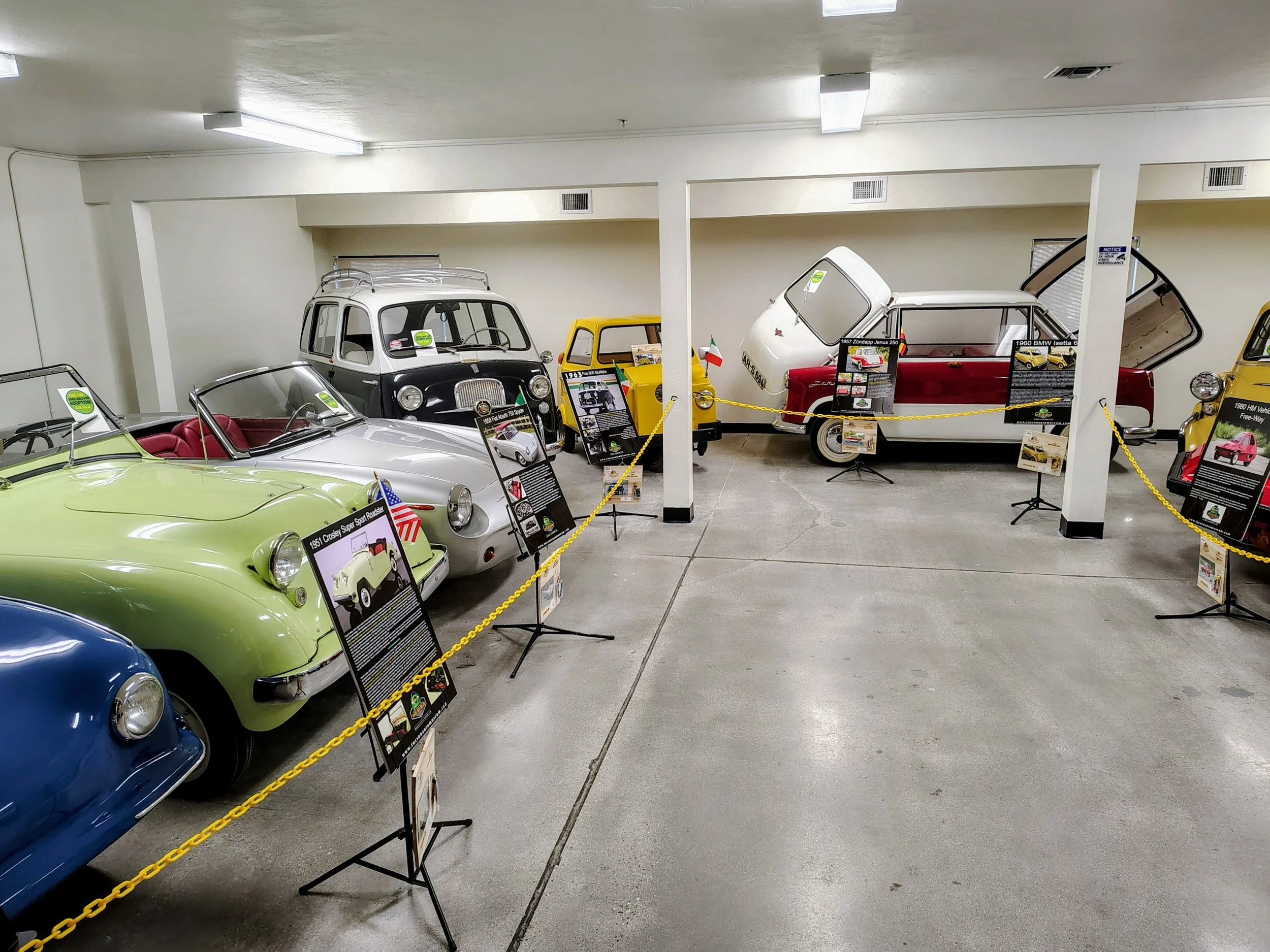
This month let’s take a step away from our decade-by-decade timeline and focus on a specific collection within the Tucson Auto Museum. Last month, we examined how World War II dramatically affected the American auto industry, with all industrial production converted to war efforts for several years. After 1945, the United States retooled its factories quickly to resume civilian production. However, the situation in post-war Germany and to some extent the rest of Europe, was far more dire.
When Germany surrendered on May 8, 1945, the scale of destruction was staggering. In Germany’s forty-nine largest cities, 39% of dwelling units were destroyed or seriously damaged. Munich alone suffered 50% overall damage and 90% destruction of its historic city center. Approximately 6.9 to 7.5 million Germans had died, representing about 8.5% of the population.
By 1945, industrial production in many European countries had fallen to less than half of pre-war levels. Germany’s industrial output dropped to a quarter of its pre-war capacity. The physical destruction was only part of the challenge. Rubble-strewn streets made maneuvering difficult, and narrow passages favored small vehicles. War-damaged bridges imposed strict weight limits. Years of neglect, bomb craters, and incomplete repairs left entire city blocks destroyed, making every square meter precious.
Germany’s industrial constraints were not solely the result of bomb damage. Allied policy played a significant role in shaping the post-war landscape, affecting what could be produced and how cities functioned. The combination of physical destruction, infrastructure limitations, and policy restrictions created an environment where microcars became both practical and necessary.
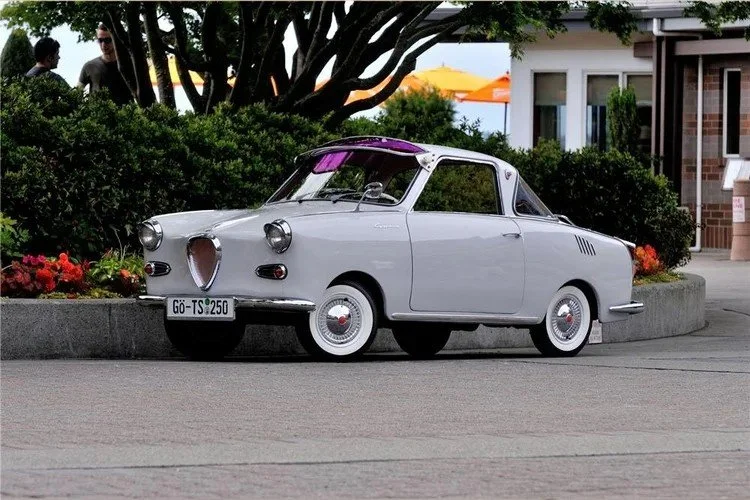
The Allies weren't subtle about their intentions. The first Allied "level of industry" plan, reduced German heavy industry to 50% of its 1938 levels by the dismantling or destroying 1,500 manufacturing plants. Germany was to be reduced to the standard of living it had known at the height of the Great Depression (1932). Car production was set to 10% of prewar levels. The plan included an important list of industries which were entirely prohibited and a few which would be permitted only until sufficient imports would be possible and could be paid for. As Germany was allowed neither airplane production nor any shipbuilding capacity to supply a merchant navy, all facilities of this type were destroyed over a period of several years. The sanctions were severe and they were meant to be, Germany had waged 2 world wars within 21 years. And many Germans who lived through the microcar era (1950s) had experienced both world wars within their lifetimes. This generational trauma helps explain the scarcity mindset that persisted even into the 1950s. As the economy recovered and the acceptance of minimal vehicles, microcars, were a literally a luxury compared to walking or a bicycle. A Goggomobile was aspirational. Never heard of the Goggomobile? You wouldn’t be alone, but TAM has not one, but two, of these mini Bavarian marvels.
Here is the paradox that most microcar history miss: By 1946, France produced 96,062 vehicles. Impressive recovery, right? Except only 5,846 private cars were registered domestically, in France, that year. Where did the other 90,000+ vehicles go? Export markets. Governments desperate for foreign currency to fund reconstruction shipped conventional cars overseas while their own citizens rode bicycles or waited years for anything with an engine.
On a wider scale, industrial production across Western Europe returned to pre-war levels by 1947. By 1951, output was 70% higher than before the war. But factories recovered before wages did. Production capacity returned to pre-war levels by 1947-1948, but workers in 1957 still earned only 55-80% of American wages. Governments prioritized exports over domestic sales. The microcar was the solution that threaded multiple needles: it required minimal steel (still allocated to priority uses), used aviation expertise applied to civilian products, consumed almost no fuel, fit through regulatory loopholes, and could be financed by working-class buyers on installment plans that conventional cars couldn't offer.
Picture a BMW engineer in Munich, winter 1955, staring at blueprints for a bubble-shaped vehicle designed by an Italian refrigerator company. Ten years earlier, he'd been calculating thrust ratios for Messerschmitt aircraft engines that powered fighters across European skies. Now, legally prohibited from touching anything aircraft-related, assembling tiny egg-shaped city cars from Iso SpA was literally the only legal option keeping BMW from bankruptcy.
The 1957 BMW Isetta 300 Convertible in our collection tells this exact survival story. In 1955, BMW licensed the Isetta design from Iso SpA, an Italian company that made refrigerators. (If you're wondering why a refrigerator company was designing cars: everyone in post-war Europe was trying everything. Iso made refrigerators. They also made a bubble car. BMW was desperate enough to license it. That's 1950s Europe in a nutshell.)
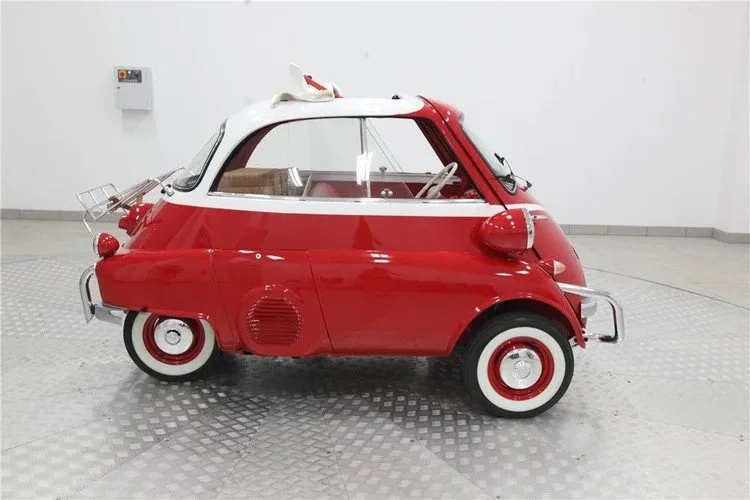
The irony: A company that had built aircraft engines for the Luftwaffe was now making Italian "refrigerators on wheels" to survive. But it worked. The Isetta kept BMW alive. Without Isetta profits from 1955-1962, 161,728 units produced, there would be no BMW 2002, no 3-Series, no M cars. The company that makes the "ultimate driving machine” today exists because Germans in the 1950s bought egg-shaped city cars that opened from the front.
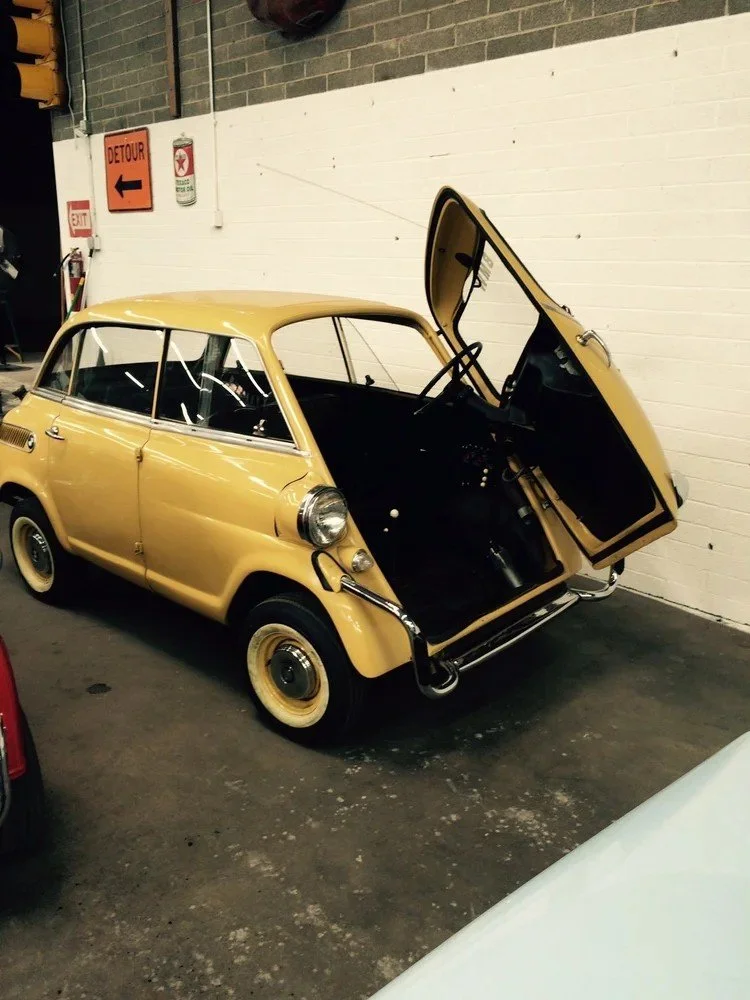
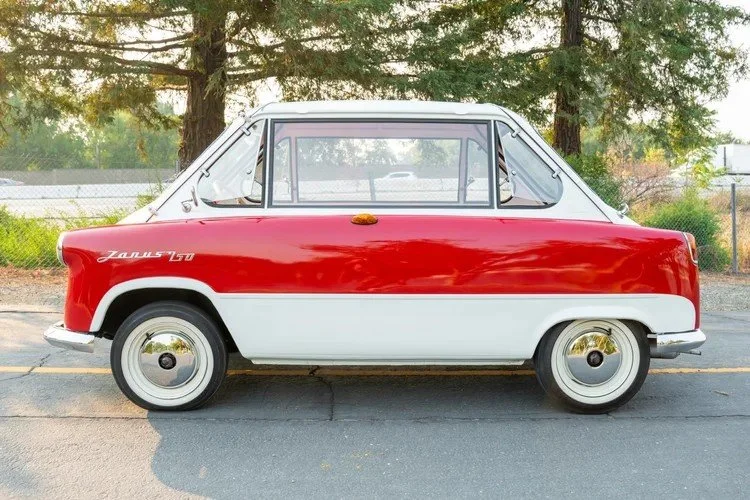
The 1957 Zündapp Janus 250 in our collection shows pure German engineering efficiency under constraint. Named after the two-faced Roman god, passengers sat back-to-back with doors at both ends. This is what happens when brilliant engineers are told "build something, anything, but you can't build what you know how to build." The Janus had 250cc (the lowest tax bracket), seated four adults (technically), got 85 mpg, and looked like nothing else on the road. Imagine sitting back to back with your passengers, imagine the social dynamics. Imagine parallel parking.
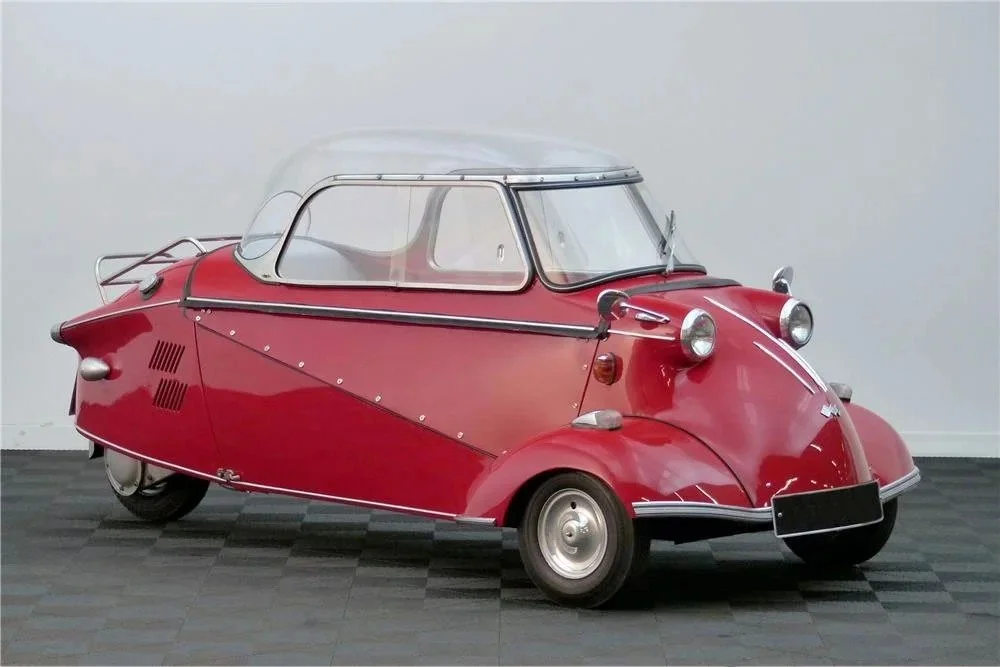
The Messerschmitt Regensburg factory, bombed in 1943, was eventually rebuilt—but not for planes. When Fritz Fend approached them in 1953 about producing his three-wheeled Kabinenroller, it wasn't an opportunity. It was the only option.
The engineering DNA was unmistakable: plexiglass aircraft canopies became bubble car windows. Tandem fighter seating became the Messerschmitt KR-200 layout. Aluminum monocoque construction from aerospace became lightweight microcar bodies. These weren't car designers thinking small—they were aerospace engineers applying everything they knew to 12-horsepower urban vehicles because that's all they were legally permitted to build. When you see TAM’s KR-200, imagine climbing in the “cockpit”, closing the canopy and steering with that aircraft-inspired yoke.
The microcar window closed as quickly as it opened. Multiple factors converged to make microcars obsolete almost overnight. As wages caught up with production capacity in the late 1950s, workers could afford conventional small cars. Real car features (four proper seats and 4 proper wheels, highway capability, trunk space, weather protection) in a package barely larger than a microcar and only marginally more expensive. By the late 1950s, European manufacturers were finally serving domestic markets with conventional vehicles. Microcars were designed for urban errands at 30 mph. On the autobahn at 60 mph, they became terrifying. The "economic miracle" (Wirtschaftswunder) created aspirations. Once you could afford better, why would you choose less?
That's why 1957 matters. It was the absolute peak of microcar production, when 100,000 units rolled off European assembly lines. By 1960, that number had collapsed to 40,000. By 1965, microcars had virtually disappeared. The microcar era proves that innovation doesn't just come from necessity, it comes from the intersection of multiple constraints, each requiring a different solution, all converging to make something entirely new inevitable.
As you walk through our microcar collection, remember: these quirky, compact machines are more than just relics of a peculiar automotive trend. They are artifacts born from a time of adversity, ingenuity, and transformation. A testament to how people and industries adapt when faced with seemingly insurmountable challenges. Each microcar carries echoes of postwar Europe, where resilience and creative engineering turned scarcity into opportunity. Their stories remind us that history is not just about the cars we drive, but about the people who built, bought, and relied on them to move forward, sometimes literally, sometimes figuratively, into a new era. Interestingly, there are two AMERICAN examples of micro-cars in that otherwise European collection. Why that is can be learned when you visit the museum (one has to do with the oil crisis from the 1970s).
So next time you see a tiny bubble car or a back-to-back Janus on display at TAM, think of our question “Did the Automobile shape society or did society shape the Automobile?”. The era of the microcar may have been brief, but its lessons in adaptation, design, and resilience still resonate today. Thank you for joining us on this journey.
Next month We will return to our decade-by-decade timeline, and look out, here comes the 1950’s! But we hope this deep dive into the microcar collection has shown you that even the quirky little vehicles in our museum tell profound stories about economics, policy, engineering, and human resilience. You just have to know where to look.