

Automobiles Through the Decades Part 5: 1950-1959, All That Chrome and No Seatbelts
All That Chrome and No Seatbelts: The Cars That Defined the 1950s
The 1950s marked a golden era for American automobiles, a decade when chrome sparkled, engines thundered, and every neighborhood became a stage for Detroit’s latest creations. After two decades of sacrifice, rationing, and war, America was ready, more than ready, to floor it. The factories that once produced tanks and bombers shifted swiftly to making cars, channeling wartime ingenuity into pure pleasure. Detroit was open for business, and business had never looked so good. Speed set the pulse, fueled by small-block V8s and an intensifying rivalry with European sports cars, while styling studios at General Motors, Ford, and Chrysler drew inspiration from the jet age, resulting in sweeping fins, wraparound windshields, bold two-tone paint, and push-button, chrome-plated promises of an exciting future. Yet beneath this dazzling showmanship, quieter concerns about safety and environmental impact began to emerge, even as most chose to ignore them. As the horsepower race escalated and tailfins soared, progress came at a cost that few were willing to acknowledge. It was an era that shaped not just the cars themselves but the culture of the open road; brilliant, bold, and blissfully unaware of the bill coming due.
The future offered tremendous opportunities, particularly for returning servicemen who, thanks to the GI Bill, gained access to higher education and new career paths. Expanding consumer credit fueled a nationwide boom in homeownership and the rapid development of suburban communities, generating an unprecedented demand for personal vehicles. Automobiles became more attainable for families, who could now purchase them through installment plans, though typically only if a male family member signed for the loan. While the automobile symbolized freedom for all, the reality was more complicated: women could choose and drive the car but rarely finance it in their own names. This new suburban landscape fundamentally transformed American social life in unexpected ways. For teenagers, the car was more than just a means of transportation; it represented true independence. This era of prosperity and greater accessibility laid the foundation for a lifestyle centered around the automobile, intertwining the promise of opportunity with everyday suburban living.
As the suburbs expanded and families sought greater mobility, the car became central to daily life, transforming not just the way Americans traveled, but where they lived, worked, and shopped. The drive-in movie theater, the drive-in restaurant, and the Saturday night cruise, an entire social world bloomed around the assumption that Americans would rather stay in their cars than leave them. Rock and Roll arrived at the same moment and the two found each other immediately, the music and the machine becoming almost inseparable. The 1950s automotive boom was thus a direct result of these interconnected forces, shaping the nation's landscape and fueling a cultural shift that celebrated freedom, individuality, and the open road. During this sweeping transformation in American society and transportation, another force was quietly reshaping the nation's priorities and infrastructure.
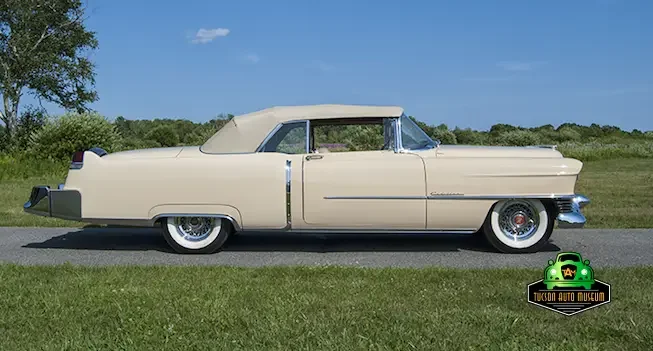
The specter of conflict lingered, not through open warfare, but in the form of a Cold War that profoundly influenced the era’s priorities. The Interstate Highway System, officially known as the “National System of Interstate and Defense Highways,” was conceived not just for civilian convenience, but as a strategic asset. Its design aimed to facilitate rapid military deployment, safeguard industrial centers, and provide routes for evacuation in the event of a nuclear attack. Just as the world’s superpowers engaged in an atomic arms race, Detroit’s Big Three automakers were locked in their own escalating battle for supremacy, one defined by horsepower. Small-block V8s, fuel injection, and ever-larger engine displacements became the ultimate symbols of status, with each manufacturer determined to outperform the others in sheer performance. Innovation didn’t stop under the hood, either. Comfort and convenience features like air conditioning, power steering, automatic transmissions, power windows, and tubeless tires revolutionized the driving experience, making cars more enjoyable and accessible than ever. However, what was glaringly absent from these advancements was any substantial focus on safety or emissions. The industry’s imagination was fixated on pleasure and performance, relegating concerns over safety and environmental impact to a distant afterthought, a shift that eventually demanded government intervention. The consequences were impossible to ignore. Since the early 1940s, Los Angeles had been shrouded in a persistent brown haze, the result of automobile exhaust reacting with sunlight to create photochemical smog. This uncomfortable truth was often overlooked or dismissed. Meanwhile, nearly every car on the road was burning leaded gasoline, releasing toxic lead particles into the air, water, and soil of every community they passed through. California responded by enacting the world’s first automobile emission standards in 1959, but the rest of the nation wasn’t yet ready to face these uncomfortable realities.
While the American auto market was dominated by the Big Three, General Motors, Ford, and Chrysler, who focused on producing sedans for the masses, a handful of postwar specialty car makers sought to offer something more distinctive. These companies produced limited-run vehicles, often hand-built and experimental, with the aim of creating cars that stood apart from the standard Detroit offerings. Many of these unique automobiles are now preserved in the collection of the Tucson Museum.
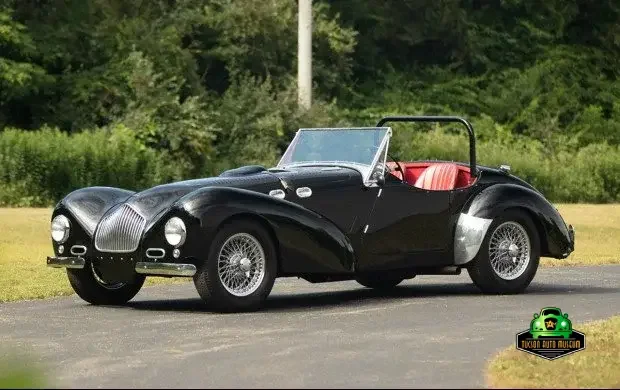
Among the notable examples from this era is the 1952 Allard K2 Roadster, an Anglo-American hybrid that skillfully combines a British chassis with the formidable power of American V8 engines. This distinctive blend of engineering and performance set the K2 apart from its contemporaries, highlighting the innovative spirit that defined these specialty car makers.
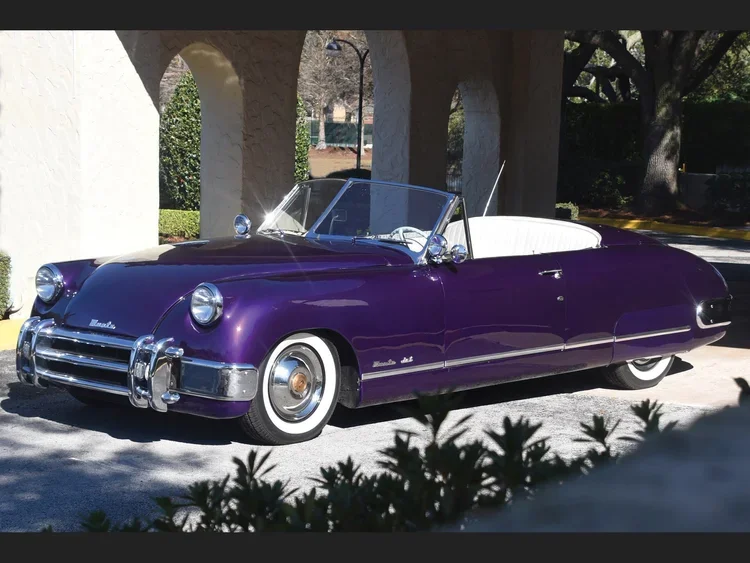
The 1952 Muntz Jet stands out as one of the era’s most intriguing specialty cars. Marketed by Earl “Madman” Muntz, this hand-built automobile featured an aluminum body and combined elements of both luxury and sports car design. Produced in very limited numbers, the Muntz Jet was notable for its exclusive features and craftsmanship, embodying the innovative spirit and bold ambitions that characterized postwar specialty car makers.
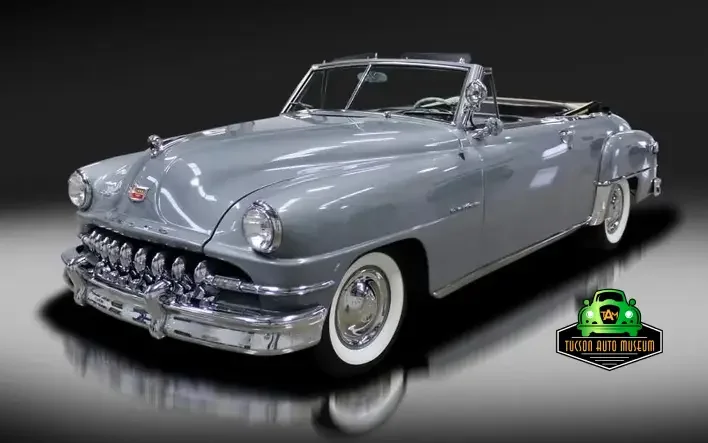
The 1952 DeSoto Custom Convertible was not a sports car, but rather a low-production luxury convertible. This model represented the final years of DeSoto’s esteemed postwar reputation for upscale vehicles, offering elegance and comfort to discerning buyers at a time when the brand was reaching the end of its prominence.
The 1954 Kaiser Darrin Roadster holds a unique place in American automotive history as one of the country’s first fiberglass sports cars. One of its most distinctive features was the innovative sliding “pocket doors,” which neatly disappeared into the front fenders, setting the Darrin apart from its contemporaries and showcasing a bold approach to both design and engineering.
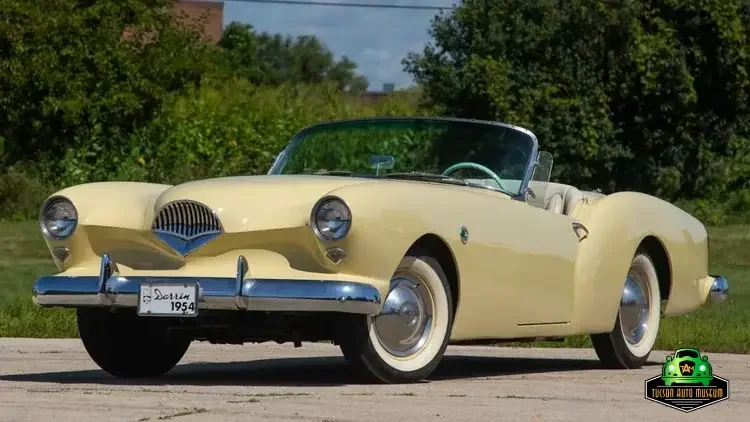
These vehicles illustrate the American sports and specialty car surge of the early 1950s, a creative moment that predated the era when the Corvette and Thunderbird would define the segment and absorb all the oxygen in the room. But before that happened a few remarkable machines had already staked their claim.
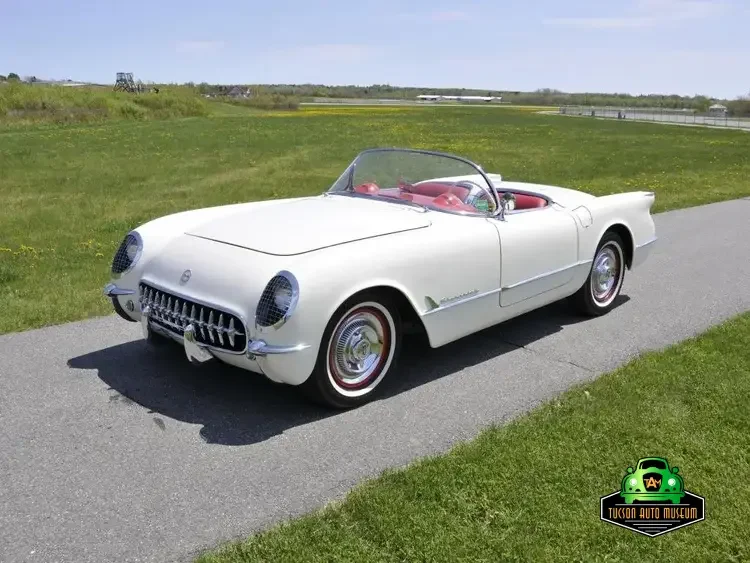
In the late 1940s and early 1950s, General Motors design chief Harley Earl grew increasingly concerned as European sports cars, such as MGs, Jaguars, and Alfa Romeos, captured the attention of returning American veterans. Having experienced these thrilling vehicles overseas, many veterans began purchasing them instead of domestic models. Earl recognized the need for an American competitor that could rival these imports in both style and excitement. This led him to initiate a design study that ultimately produced the Corvette concept. Unveiled at the 1953 GM Motorama show in New York, the Corvette was met with an enthusiastic response from the public, prompting GM to fast-track its production. The car’s name was inspired by a class of swift naval warships, reflecting its intended performance and spirited character.
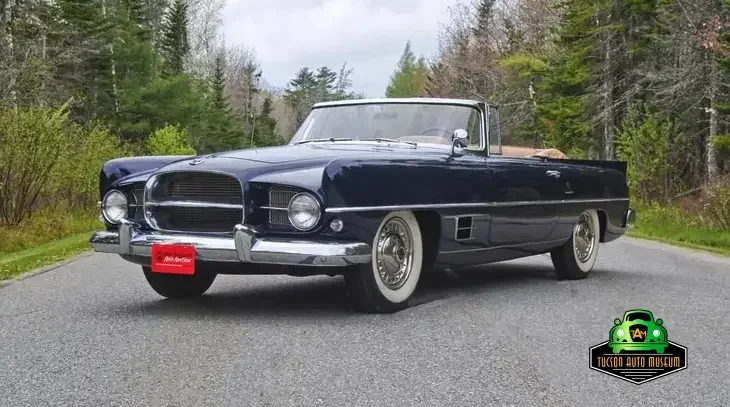
GM built the first 300 Corvettes in Flint in 1953. In 1954, a dedicated plant opened in St. Louis exclusively for Corvette production. That year, Chevrolet manufactured 3,640 units, and while they looked spectacular, the model faced serious challenges. Equipped with a 6-cylinder engine and a two-speed automatic transmission, the Corvette was priced at nearly $3,000, more expensive than a Cadillac. The European cars it was designed to compete with delivered better performance for less money. By the end of the 1954 model year, nearly a third of the Corvettes remained unsold, highlighting an identity crisis: the car was uncertain about its true purpose. GM seriously considered canceling the entire program.
What ultimately saved the Corvette? First, Ford announced the Thunderbird for 1955, giving GM a direct competitor and a reason to keep the Corvette alive. Second, Zora Arkus-Duntov, a Belgian-born engineer and racing driver who joined GM in 1953, presented a clear vision of what the Corvette needed to become. He became the car’s most passionate internal advocate at a time when almost everyone else was ready to abandon the project.
What followed was a dramatic evolution, paralleling the broader changes sweeping America in the 1950s. The Corvette received a small-block V8 engine, and soon after, a manual transmission. In 1956, the model was redesigned with a new body, and by 1957, fuel injection technology enabled the car to produce 283 horsepower from its 283 cubic inch engine. The vehicle once dismissed as merely attractive, but underwhelming was now emerging as a true powerhouse. And what an icon Corvette would become. By the early 2000’s Corvette marketing would develop a bit of an attitude and would even run an ad campaign with the tag line “They don’t write songs about Volvos”, while showing the rear view of a 1963 Split window Corvette.
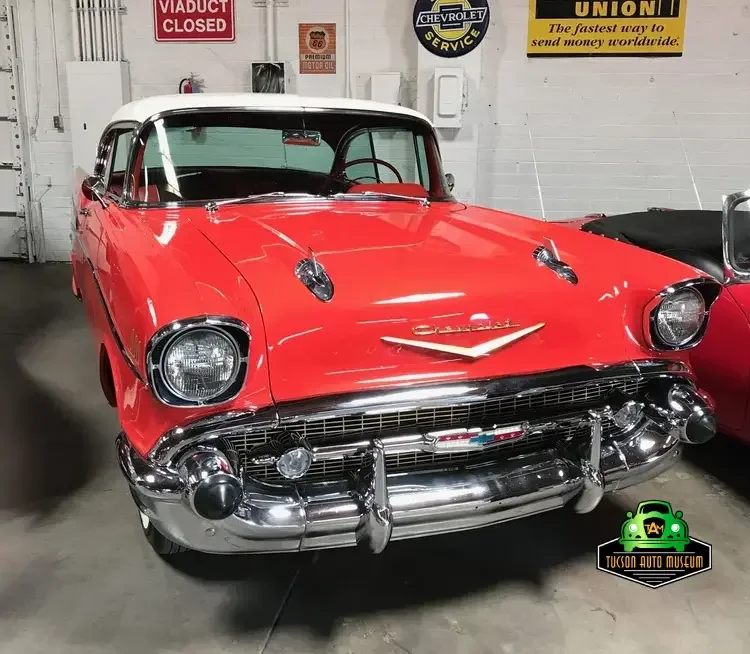
The Corvette may have been fighting for its life in the early years of the decade, but not every 1950s icon had to struggle for its place in history, case in point the 1957 Bel Air that is in the museum’s collection. Over the years these vehicles have been customized, hot rodded, lowered, restomodded, and reimagined more than almost any other American classic. It is simultaneously a show queen, a hot rod platform, a parade car, and a daily driver depending on who owns it. It is the decade’s most democratic icon, expensive enough to be aspirational, but common enough that almost everyone knew someone that owned one.
Chevrolet produced three models that year: the one-fifty, two-ten, and the Bel Air. All three vehicles used the same frame, body shell, doors, and rooflines, they differed in chrome, trim, and interior components. The Bel Air was the top of the line, carrying the highest price tag. Ours is a two-door hardtop with a 283 Power Pack engine breathing through a four-barrel carburetor, the serious middle ground for performance enthusiasts. Along with an automatic transmission and power steering and power brakes. It is not merely a representative of the decade, it is the decade, rendered in steel and chrome and driven right up to the present day.
The 1950s were a time when America never stopped moving. The cars of this decade represent all of society, from the scrappy specialty builders at the beginning of the decade to the chrome and glass icons of its close. This was a moment in time when the automobile became more than just transportation, it became an aspiration and the identity of our nation’s confidence in its own future.
It was a decade of inspiration and blindness. The automobile industry gave us the small block V8 with one horsepower per cubic inch and the wrap around windshield. But could not find the will to install a decent seatbelt or find a way to clean up its own exhaust. The Automotive designers could sculpt the future one line at a time but couldn’t be bothered to protect the people inside the car. On the outside the chrome gleamed, under the hood the engine roared and every tailpipe exhaled something nobody was ready to talk about.
Yet it’s precisely that tension, between the promise and the price, that makes the 1950s so fascinating. The machines of that era were built by people who, with all sincerity, believed in the future of the Automobile and of America. And we are left with our question “Did the automobile shape society or did society shape the automobile?”. Through the lens of the 1950s we see the promise and the price.
The 1950s, as the best decades always do, left us with a surprise ending. On January 3, 1959, Alaska became the 49th state. And eight months later Hawaii followed as the 50th. So, the 48-star flag that had been flown so patriotically across this nation for the remarkable decade was quietly retired. America was larger than it had ever been, and its future was two stars brighter.
With the suburbs expanding and the highways still being built, that 1957 Bel Air was somewhere on a freshly poured stretch of interstate doing exactly what it was built for, heading somewhere new, with the radio on, the chrome gleaming in the sunlight, and not a seatbelt in sight.