The numbers tell a story of the biggest military build-up in history. At peak production, Ford's Willow Run plant produced one B-24 Liberator bomber every 63 minutes. The sprawling facility was so far from Detroit that Ford built a special 27-mile highway, called the "Bomber Highway", to provide workers access to the plant, a road that would later become part of Interstate 94. The scale of operations was staggering in every dimension: the 12 Willow Run cafeterias, run by Edith Clark (listed in Ford personnel records as "E.M. Clark" to hide the fact that a woman was in charge), produced 42,000 meals daily, more than the entire Nazi army received. General Motors manufactured $12.3 billion worth of war material, including aircraft engines, tanks, trucks, and the amphibious DUKW "Duck" that would storm the beaches of Normandy. Chrysler built tanks at the Detroit Arsenal Tank Plant, while Packard produced Rolls-Royce Merlin engines for P-51 Mustang fighters.
This complete industrial conversion demonstrated something unprecedented: the automotive industry's manufacturing expertise, precision tooling, and mass production capabilities were directly transferable to military needs. The scale of the transformation was dramatic, in 1940 and 1941 the industry produced over 4 million vehicles, before civilian manufacturing ceased entirely in February 1942 and would not resume until July 1945. The assembly line techniques pioneered by Henry Ford two decades earlier now built the machines that would win a world war. The difference between WWI's chaotic mobilization and WWII's seamless transformation came down to preparation and planning. The Army Industrial College, established in 1924 specifically to study WWI's failures, spent twenty years developing strategies for future industrial conversion. Those two decades of careful study paid enormous dividends—WWII mobilization avoided the disorganization that had plagued the previous war, resulting in unprecedented production efficiency and output.
The war years fundamentally reshaped automotive design philosophy, though these changes wouldn't fully manifest until peace returned. Engineers and designers working on military vehicles gained experience with aerodynamics, lightweight materials, and functional efficiency that peacetime luxury had never demanded. The streamlined shapes necessary for aircraft found their way into automotive thinking. Aluminum and high-strength steel alloys developed for military applications waited in the wings for civilian use.
Perhaps more significantly, the war democratized technical knowledge. Millions of Americans, including vast numbers of women, learned mechanical skills in defense plants that would forever change their relationship with automobiles. The car was no longer mysterious; it was a machine to be understood, maintained, and even modified.
"Rosie the Riveter" wasn't just building bombers—she was assembling the confidence and capability that would reshape post-war society. In many ways, she represented the next evolutionary step from 1920, when women gained the right to vote. Political equality had opened the door, but economic independence through skilled industrial work pushed it wider. Women composed up to 65% of the workforce at some aviation plants, and their presence in automotive factories was nearly as significant. While many women left factory work after 1945, their wartime experience permanently altered assumptions about capability, independence, and mobility.
The United Auto Workers union, which had fought bitter battles for recognition in the 1930s, emerged from the war years with unprecedented power. The massive strikes of 1945-1946—particularly the 113-day GM strike—established new patterns of labor relations that would define the industry for decades. These labor agreements directly affected car prices, production schedules, and the economic bargain that would fuel post-war prosperity.
When civilian production resumed in late 1945, American automakers faced a market unlike any in history. Sixteen million new cars had been sold in the United States during the 1930s, but virtually none between 1942 and 1945. Millions of families had been saving money with nothing to buy. The pent-up demand was overwhelming.
Initially, manufacturers simply dusted off 1942 designs and started building. The 1946 models were essentially pre-war cars—the industry needed time to retool for genuinely new designs. But even these warmed-over sedans sold instantly, often at premiums above sticker price. Waiting lists stretched for months. A used car in good condition could sell for more than its original purchase price.
This was a seller's market beyond anything seen before or since, and it fundamentally reset consumer expectations. Before the war, buying a car meant negotiating, comparing, shopping around. Now it meant waiting, hoping, and feeling grateful when your name finally came up. The experience of scarcity would drive the abundance mentality of the 1950s.
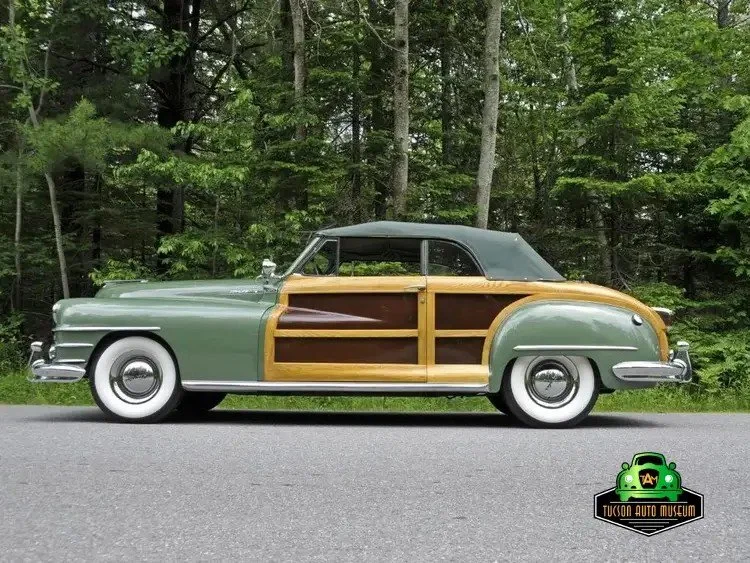
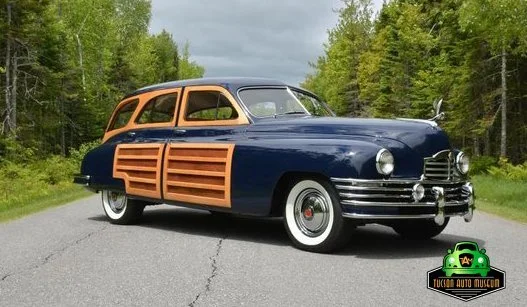
The museum's 1940s vehicles tell this story in chrome and steel. The 1948 Chrysler Town & Country represents the immediate post-war period, when manufacturers began experimenting with new ideas—in this case, the "woody" wagon that bridged utilitarian and luxury markets. Its wood-bodied construction spoke to material shortages and traditional craftsmanship, even as its powerful inline-eight engine promised the performance hunger of the coming decade.